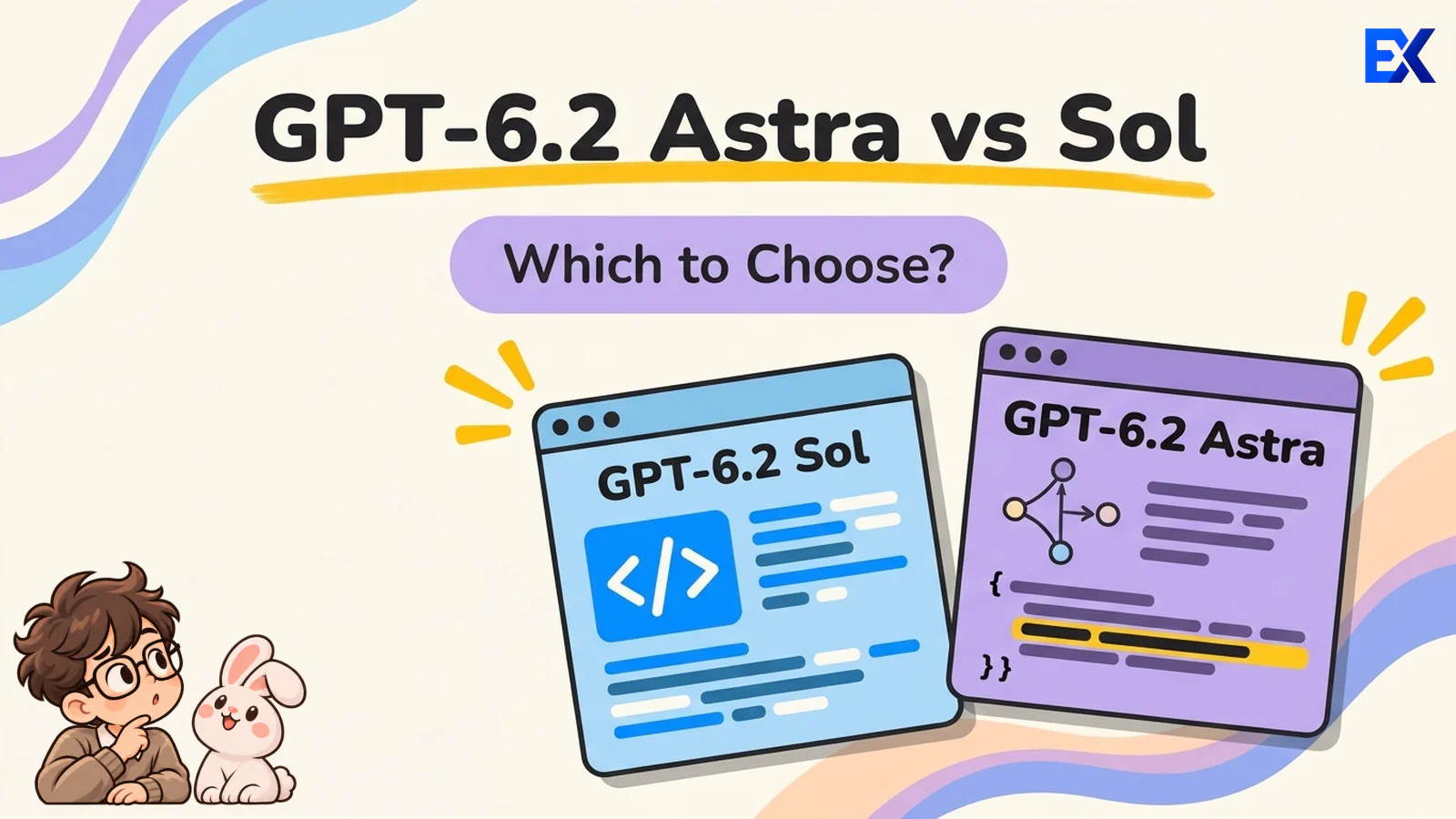
GPT-6.2 Astra and GPT-6.2 Sol are OpenAI models introduced on November 17, 2026. Astra targets demanding reasoning, complex coding and professional deliverables. Sol balances intelligence and cost for everyday coding and agent workflows. Start with Sol and escalate to Astra when your task's measured requirements warrant it—rather than assuming the larger model must run every step.
What changed with GPT-6.2?
OpenAI announced both models on November 17, 2026, emphasizing higher-quality professional work, token efficiency and better multi-step execution. The official announcement highlights Astra for complex codebases, interactive frontends, documents, spreadsheets and extended work. Sol is positioned as a flexible daily driver for teams and developers.
Neither GPT-6.2 Astra nor GPT-6.2 Sol should be confused with earlier GPT-6 Astra or GPT-6.1 Sol versions. Names matter when comparing access, benchmarks and prices.
GPT-6.2 Astra vs Sol: comparison
Dimension
GPT-6.2 Astra
GPT-6.2 Sol
OpenAI positioning
Frontier model for hardest projects
Efficient everyday work and agents
Strong-fit use cases
Difficult reasoning, complex coding, rich professional deliverables
Verified against OpenAI sources on November 21, 2026. These are Standard API token rates, not ChatGPT subscription fees or EmpireX retail prices. Other processing tiers and limits can differ. Sources: API model catalog and launch announcement.
Why choose Astra?
OpenAI positions Astra for hard, multi-stage reasoning, repository-scale changes, rich professional documents and complex interactive designs. Published benchmarks are results from OpenAI's disclosed evaluations, not independent tests conducted by EmpireX. No model is guaranteed to win every workload.
Why choose Sol?
Sol focuses on efficiency and versatility. It is worth testing first for routine software maintenance, documentation and clearly specified agent steps. In the Standard API price table, Astra's three token rates are four times Sol's; total per-task costs still depend on token usage, retries and execution strategy.
Illustrative GPT-6.2 Astra and Sol comparison for complexity and API token rates
Worked API cost example
Consider an illustrative, uncached workload consuming 2 million input tokens and 500,000 output tokens at Standard rates:
Calculation
Astra
Sol
Input cost
2 × $8 = $16
2 × $2 = $4
Output cost
0.5 × $40 = $20
0.5 × $10 = $5
Total
$36
$9
This is arithmetic based on published rates, not an observed benchmark run. Production evaluation should include tool calls, cache behavior, retries, latency, test pass rate and human review time. Ultrafast and other processing tiers use their own pricing.
Illustrative API cost comparison for GPT-6.2 Astra and Sol: $36 vs $9 for the same example workload
Which model should developers use?
Start with Sol for
Isolated functions, known bug fixes, unit tests and technical documentation.
Agent pipelines with defined steps and acceptance criteria.
Frequent coding or processing where operating cost matters.
Escalate to Astra for
Difficult, cross-module defects or unclear root causes.
Multi-repository refactors with stringent integration requirements.
Complex presentations, interactive experiences, or deep analysis that fail your Sol baseline.
Practical workflow: run a controlled Sol test first, record failures and retry with Astra using the same inputs and success criteria. A single screenshot or demo is not a meaningful evaluation.
Illustrative workflow: try Sol, test outcomes, then escalate to Astra if needed
Example: routing coding tasks by difficulty
Suppose a team needs to fix an API pagination issue and add regression tests:
Define success: reproduce the bug, pass existing tests, add regression coverage and avoid unrelated changes.
Try Sol: provide relevant files, failing output, runtime environment and test command; ask for a minimal patch.
Verify: run tests, inspect the diff and review permission/security implications.
Escalate when needed: send Astra remaining failures, the attempted patch and constraints.
Measure full cost: tokens, retries, reviewer time and any regressions.
This is a recommended hypothetical procedure, not a claim of performance testing by EmpireX.
Where are Astra and Sol available?
Per OpenAI's help documentation, GPT-6.2 Astra and Sol can be selected in ChatGPT Work and Codex for eligible users. Regular Chat retains a separate model picker. The release announcement names Plus, Pro, Enterprise and Edu access, subject to rollout and workspace controls. API IDs are gpt-6.2-astra and gpt-6.2-sol. A ChatGPT subscription does not automatically provide billed API tokens.
How to verify access
Open ChatGPT Work or Codex while signed in.
Inspect the model selector for the exact GPT-6.2 names.
If they are missing, verify plan eligibility, app version and workspace permissions.
For API use, inspect your organization's model access, rate limits and current pricing.
Is upgrading to Plus, Pro or Codex worthwhile?
Decide on the features, workspace access, quotas and tools you actually need—not solely the model name. Pro is not unlimited across every model, product or API use. If you need higher throughput or Ultrafast, inspect the entitlements of your exact Pro tier.
The models can still be wrong or generate insecure code. OpenAI reports stronger safeguards, particularly for cybersecurity tasks, which may also constrain some legitimate security research. For sensitive data, follow the applicable product privacy and access rules.
Avoid relying solely on vendor benchmarks. Evaluate representative tasks in the same environment, with comparable reasoning settings, sufficient trials and independent verification.
Frequently asked questions
Is Astra always better than Sol?
Not across all tasks. Astra is positioned for harder problems; Sol may be a better default when efficiency and cost matter.
Are both models available through API?
Yes: gpt-6.2-astra and gpt-6.2-sol. Both support Responses API and Chat Completions; tool calling requires Responses API, per OpenAI's November 17 changelog.
Does a ChatGPT Plus subscription include API usage?
No. API billing is separate from the consumer subscription.
How much more expensive is Astra?
At published Standard API token rates, input, cached input and output are four times the per-million-token rates of Sol. Actual workflow totals vary.
Should Astra power every coding task?
Usually start by evaluating Sol; use Astra when complexity and quality requirements justify it.
Conclusion
Pick GPT-6.2 Sol as a cost-aware candidate for routine coding, agents and everyday work. Pick GPT-6.2 Astra for difficult professional tasks or when a controlled Sol test does not meet acceptance criteria. Verify where the model is accessible—Work, Codex or API—and measure total task cost before scaling.